
What Does a Chiropractor Do for Back Pain?
Plenty of people have a back story. Maybe it began with a “tweak” picking something up off the floor, or a long week of driving, or lifting something heavy in the garden. It settled down, then came back. You’ve been getting on with it, and quite often that’s the problem: it’s easy to carry on until the back makes the decision for you. If you’ve ever wondered what a chiropractor actually does for back pain, this is a plain-English guide. A note first: at Roots Chiropractic in Horsham, we don’t treat back pain or any medical condition. What we do is look at how well your spine and nervous system are working, because that’s what runs your back.
Why the back is more than just muscle
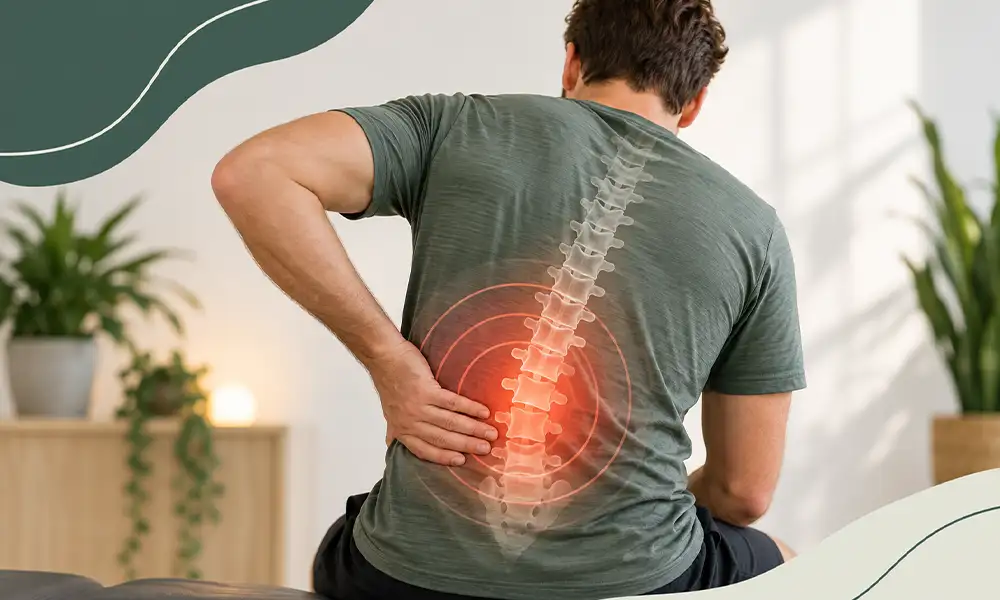
When your back hurts, it feels like a muscle problem. But your muscles only do what the nervous system tells them to. Along either side of your spine sit small, deep muscles called multifidi. They feed a constant stream of information to the brain about where each part of your spine is and how it’s moving. When particular spinal segments lose their coordination and stability, those muscles can stop firing properly. The brain gets less information, or more confusing information. Its response is to protect you, and protection usually looks like tightness, spasm, stiffness or that “locked up” feeling.
Unstable segment → Unclear signal → Protective response → Back tension
This is why stretching, heat and pills can take the edge off without changing the pattern. The tightness isn’t the cause. It’s the body’s attempt to cope.
Why people often end up in this pattern We see men from every walk of life, but some themes come up again and again:
- Work. Long hours at a desk, in a van or on your feet, often with a lot of sustained positions
- Training. Lifting, running, five-a-side or golf, sometimes on top of old injuries that were never
fully adapted to - Stress. Pressure at work, at home or both, which keeps the nervous system on high alert and
muscle tone switched on - Old injuries. Falls, sports knocks, a car accident years ago, a hard landing off a bike
- Putting it off. Pushing through rather than looking at what the body might be telling you
None of these are “bad” in themselves. They become an issue when the nervous system can no longer
adapt to them.
So what does a chiropractor actually do?
At Roots, here’s what to expect.
- We listen. Your story matters. We want to know when it started, what else was going on, previous
injuries, accidents, your work, your training and your stress. - We assess your whole system, not just the sore spot. Where it hurts and where the cause sits are
often different places. We use:
- Global Tonal Assessment: how muscle tone is organised across your body
- Integrated Specific Spinal Assessment: which segments of your spine aren’t functioning as they
should - Insight Scans (HRV, thermography and sEMG): objective measures of how your nervous system
is responding, so we have numbers to track
- We make specific adjustments. Chiropractic adjustments are precise and gentle, aimed at improving
how particular spinal segments move and communicate. The aim isn’t to “crack” your back. It’s to
support clearer signalling between your brain and body. - We track your progress. We re-check the objective measures over time, so you can see what’s
changing rather than rely on how you feel on a given day
What practice members often report
- Practice members tell us they notice things like:
- A back that feels less guarded and more mobile
- Less tension through the neck, shoulders and hips
- Feeling more steady and able to rely on their body
- Better recovery after exercise or a long day
We don’t promise outcomes. What we can say is that when the nervous system is functioning better, symptoms often shift as a by-product.
Is it only for people who are in pain?
No. Many people wait until the back has become an issue, but it’s just as valid to look at how your system is coping before it gets to that point. Your nervous system is adapting to your work, training and stress every day.
Frequently asked questions
Does it hurt?
Care is gentle and specific. Some people feel a little tired or achy afterwards as their body adapts, and
we’ll talk you through what to expect.
Do I need a referral?
No. You can book a consultation directly with us.
I already see a physio or go to the gym. Is that a problem?
Not at all. We’ll ask about what you’re doing and work alongside it.
When should I get medical help instead?
Seek urgent medical care if back pain comes with loss of bladder or bowel control, numbness around the groin or inner thighs, progressive weakness in the legs, fever or unexplained weight loss, or follows a significant injury.
The bigger picture Your body is intelligent. When it’s functioning as it should, it’s well equipped to regulate, adapt and heal. Back pain is feedback, and our job is to help you understand what it’s pointing to and support your
system so it can respond.
If your back has been holding you back, we’d welcome the chance to take a proper look. Book a
consultation at Roots Chiropractic in Horsham, or send us your questions. I’m here to help.
Kindest,
Morgan