
Ask most people how to fix their posture and you’ll hear the same advice: pull your shoulders back, sit up straight, tuck your chin in. You try it for ten minutes, you feel awkward, and by lunchtime you’re back where you started.
There’s a reason for that, posture isn’t a position you hold. It’s the result of how your nervous system organises your body, moment to moment. At Roots Chiropractic in Horsham, we don’t treat posture. We look at the movement options your spine and body have, because the more options you have, the less your body needs to guard and hold tension.
Posture is a by-product, not a goal
Your body is always adjusting to gravity, to what you’re doing and to what it senses. A good posture isn’t one fixed shape. It’s the ability to move easily between many shapes: sitting, standing, bending, reaching and turning.
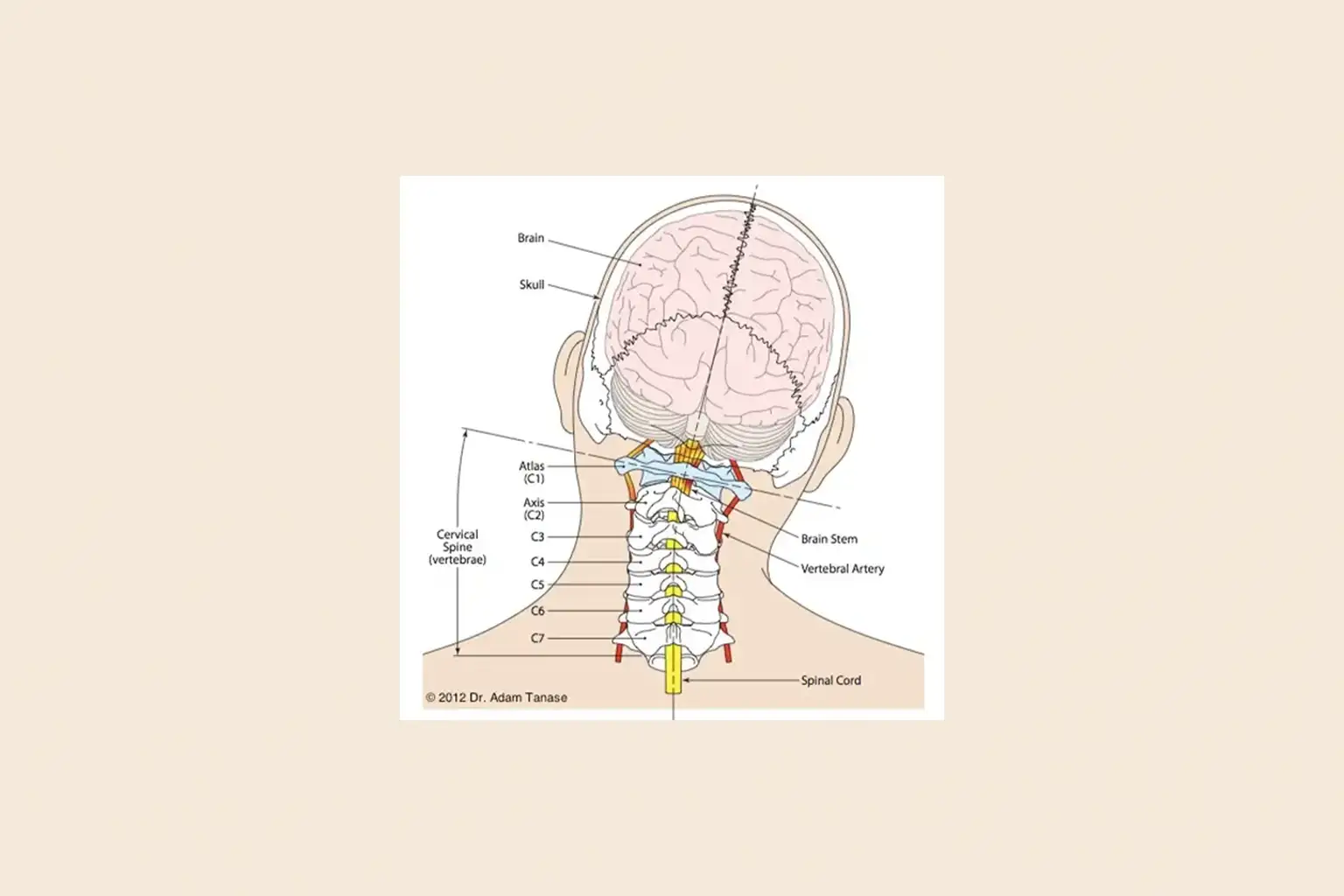
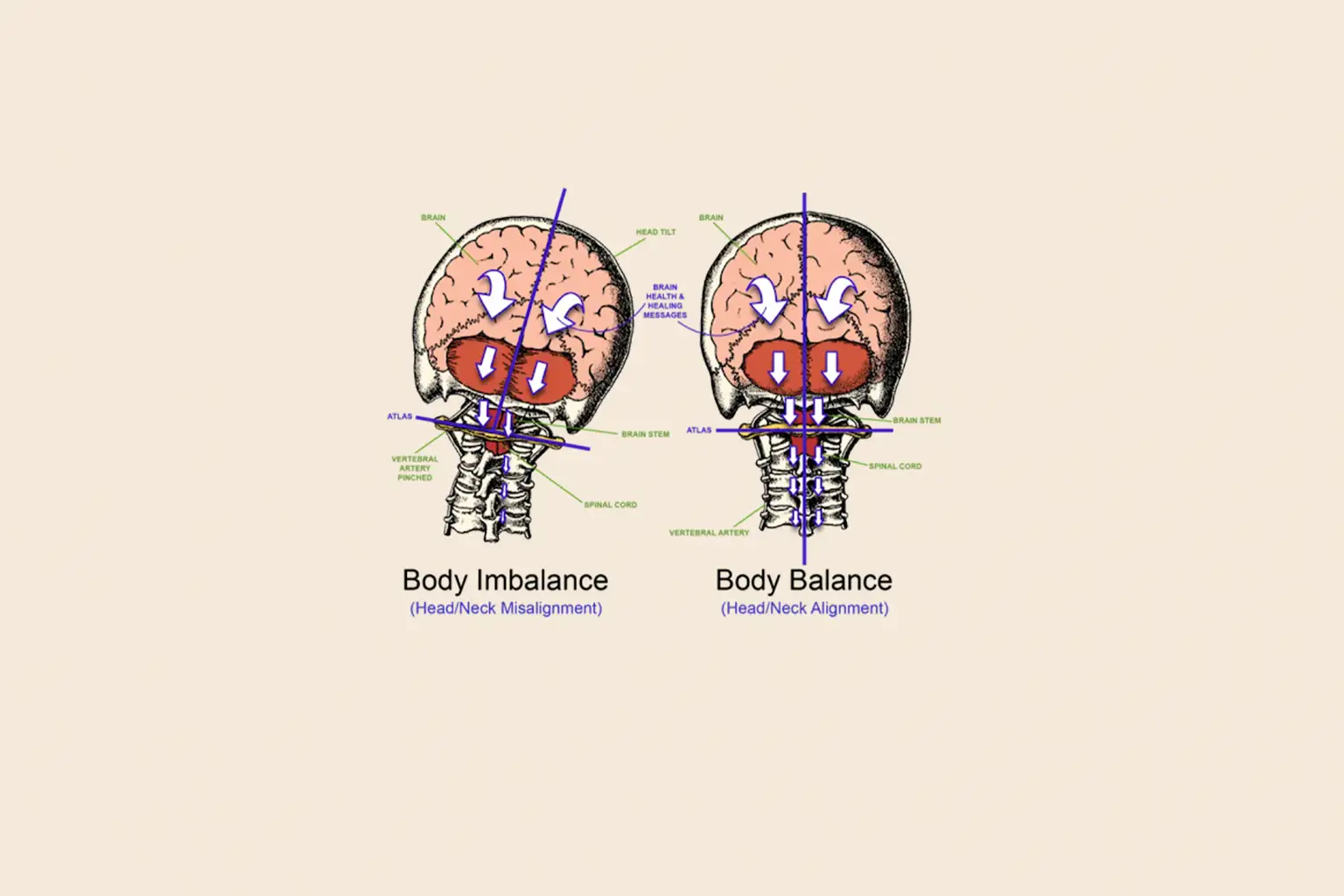
When your spine moves well and your nervous system is getting clear information, your body can choose from lots of options. When parts of the spine aren’t moving or communicating well, the nervous system has fewer options available. It narrows down to what feels safe, and that tends to look like rounded shoulders, a forward head, a flattened lower back or a body that’s stuck on one side.
That’s guarding. Telling someone to “stand up straight” asks them to override it. It doesn’t change the reason for it.
Fewer movement options → More guarding → Postural patterns that stick
Why posture goes bad
Postures rarely “go bad” overnight. They are built, slowly, by repetition:
- Repeated positions, such as desks, steering wheels, sofas and phones
- Old injuries, such as falls, whiplash and sports knocks that the body adapted around
- Stress, which keeps muscle tone switched on, particularly through the neck, jaw and shoulders
- Breathing patterns, where shallow upper-chest breathing changes how the ribcage and neck are used
- Lack of movement variety, so the same patterns are used day after day
None of these are “bad” on their own. They become a problem when the nervous system can no longer adapt to them.
The seven diaphragms
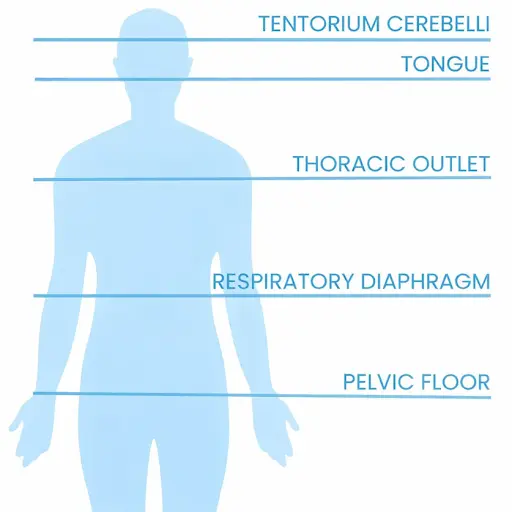
When we look at tension patterns through the body, we pay particular attention to the diaphragms. In the osteopathic literature, “diaphragms” refers to horizontal regions of soft tissue, such as muscle, fascia and membranes, that are closely connected with each other and with the breath. Different traditions count them differently. These are the seven we think of as a useful map:
1. Tentorium cerebelli, the membrane inside the skull that separates the brain from the cerebellum
2. Floor of the mouth and tongue (with the hyoid), which links the jaw, tongue and the front of the neck
3. Thoracic outlet, the doorway between the neck and chest, through which nerves and blood vessels travel to the arms
4. The respiratory (thoracic) diaphragm, the main muscle of breathing
5. Pelvic floor, which works in partnership with the respiratory diaphragm
6. The back of the knee, which is sometimes described as a diaphragm-like region
7. The sole of the foot, which connects the ground to the rest of the body through fascia
Reading the research, these regions are described as being closely related through fascia, nerves and breathing. When one is holding a lot of tension, the others tend to be affected. Studies on the topic are still emerging, and we see this as a useful way of understanding patterns, not a guarantee. In practice, we’re looking for where tension is concentrated across this chain, and where the spine isn’t moving well, because the spine is where the nervous system is most able to be supported.
Where chiropractic fits
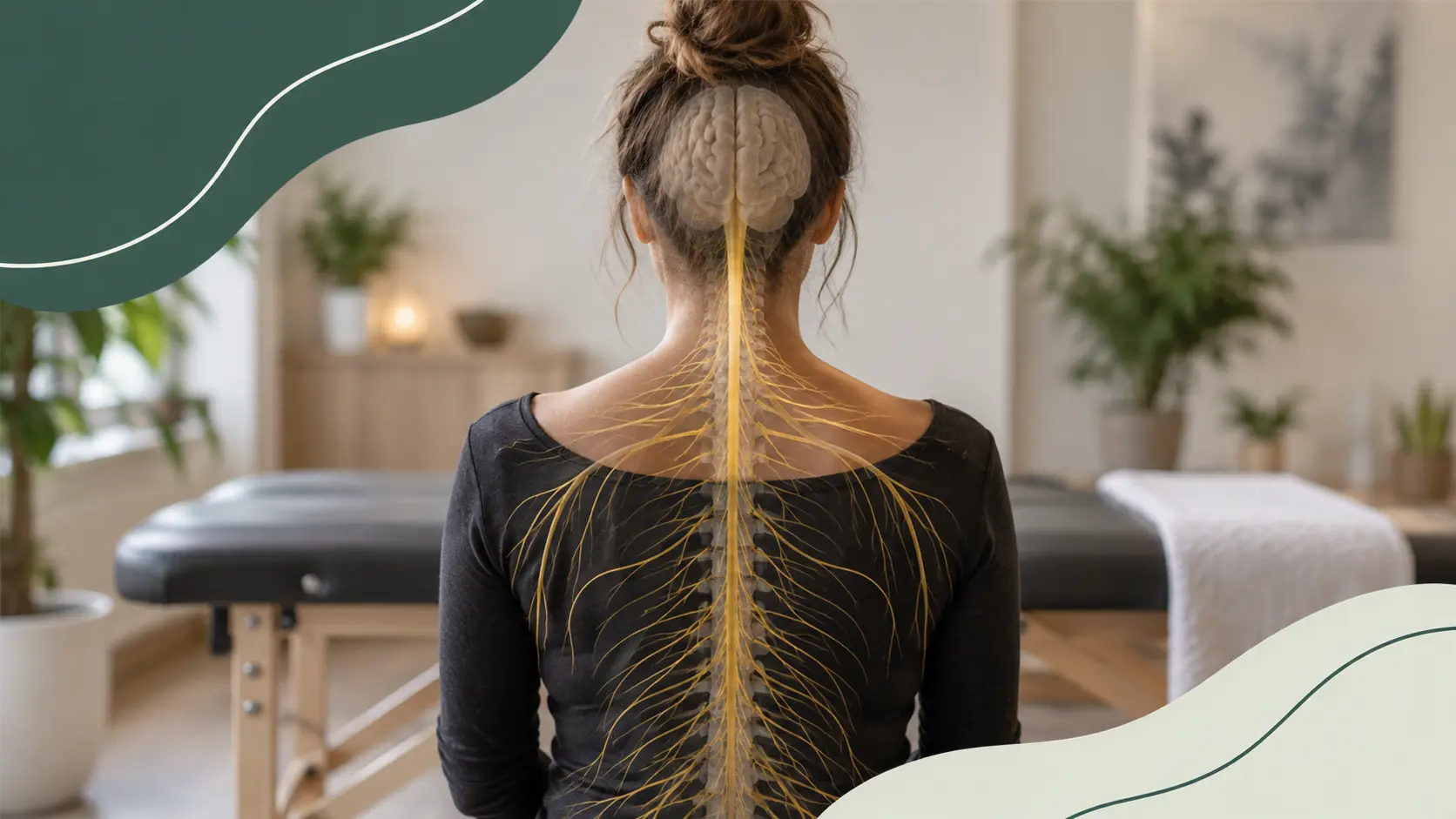
Chiropractic care focuses on improving and maintaining movement of the spine and the function of the nervous system. By making specific adjustments to areas in and relative to the spinal column that aren’t moving optimally, we aim to give your body more options, so it doesn’t have to guard so much.
Practice members tell us they often notice that:
- Standing and sitting feel easier and less effortful
- Tension through the neck, shoulders and back is less constant
- Breathing feels freer
- They feel more mobile and more “in” their body
We don’t treat posture. These are by-products of better nervous system function.
What to expect at Roots
Our process is detailed and specific:
- Global Tonal Assessment: how tone is distributed across your whole body
- Integrated Specific Spinal Assessment: which segments of the spine aren’t moving as they should
- Insight Scans (HRV, thermography and sEMG): objective measures of nervous system function, so we can track change over time
Frequently asked questions
Will chiropractic correct my posture?
We don’t treat posture. We support spinal movement and nervous system function, and many people notice their posture feels different as a result.
Do I need to keep doing my posture exercises?
Keep doing what you’re doing and tell us about it at your consultation. We’re happy to work alongside your other practitioners.
Is poor posture dangerous?
Posture is rarely the whole story. If you have pain that’s severe, new numbness or weakness, or symptoms that worry you, speak to your GP.
The best posture is the one you don’t have to think about. When your nervous system has more movement options, it doesn’t need to hold you in place.
If you’d like to explore what’s behind your own patterns, book a consultation at Roots Chiropractic in Horsham. I’d love to help.
Warmest regards,
Morgan
Sources
- The Five Diaphragms in Osteopathic Manipulative Medicine: Myofascial Relationships, Parts 1 and 2. Cureus (2020). PMC7243635 and PMC7249764.
- The Five Diaphragms in Osteopathic Manipulative Medicine: Neurological Relationships, Part 2. Cureus (2020). PMC7372241.